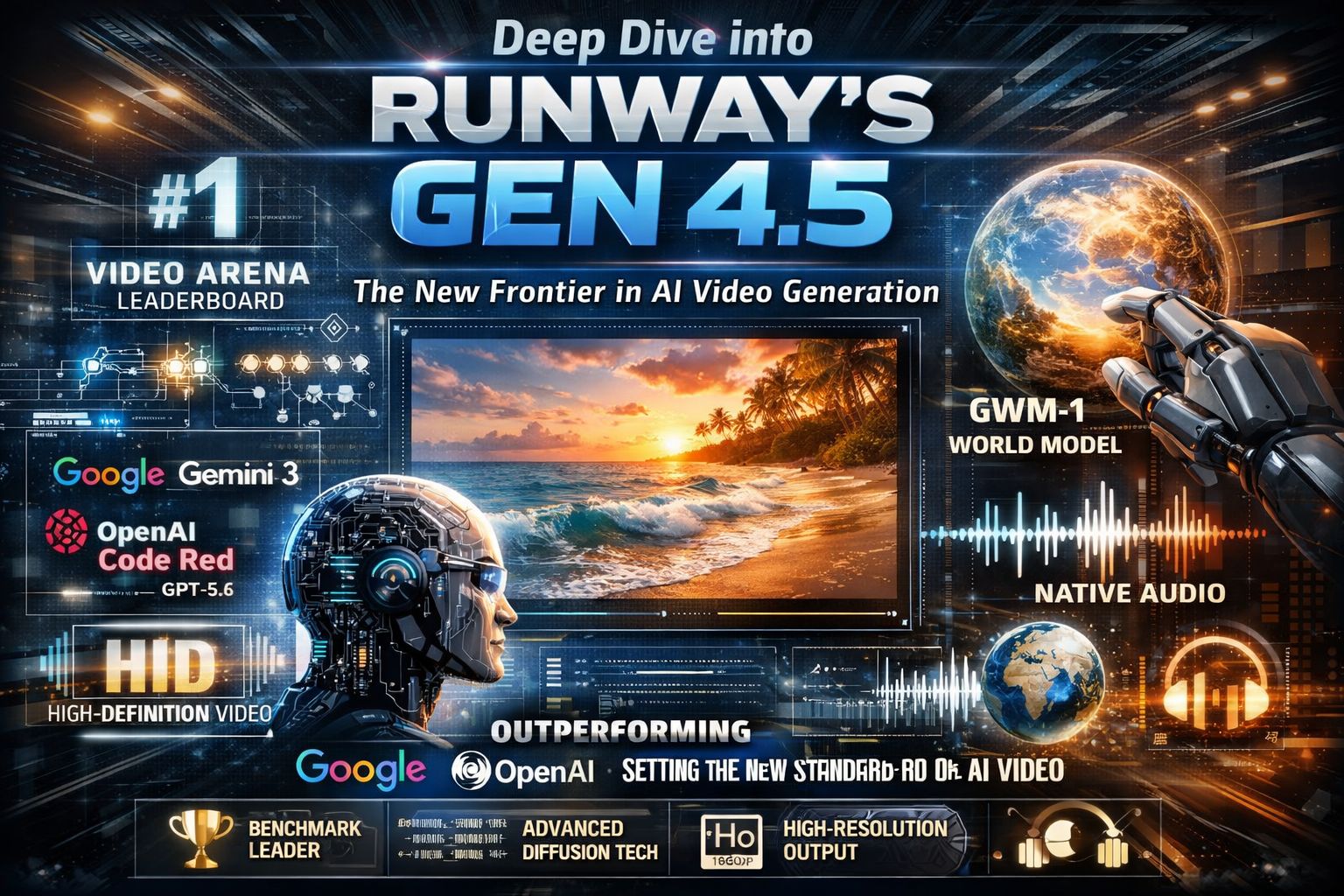
In late 2025, Runway dropped the Gen 4.5 video generation model, marking a significant leap in how AI can create high-definition videos from text prompts. This release shook up the AI video scene by overtaking giants like Google and OpenAI on a respected independent leaderboard. If you’re curious about what makes Gen 4.5 tick, why it matters, and how it compares to competitors, let’s break it down with depth and clarity.
What is Runway Gen 4.5?
At its core, Gen 4.5 is a text-to-video generation model. It means you provide a descriptive prompt—say, “a calm beach at sunset with gentle waves”—and the model constructs a believable, high-fidelity video capturing that scene. Compared to prior models, 4.5 shines in producing sharper, more detailed videos that respect temporal consistency—the smooth flow between frames—while integrating realistic motion and elements.
What distinguishes Gen 4.5 is its placement at #1 on the Video Arena leaderboard, an independent benchmark platform curated by Artificial Analysis, comparing various AI video models on quality, fidelity, and consistency. This is not just hype from Runway’s marketing; it’s peer-recognized validation that Gen 4.5 currently leads in delivering compelling videos from text prompts.
Technical Underpinnings: How Does Gen 4.5 Work?
While Runway has not publicly released every architectural detail, from typical state-of-the-art text-to-video systems and hints available, we can infer some key components underpinning Gen 4.5:
- Transformer-Based Backbone: These models typically leverage transformer neural networks to understand and process the input text prompt effectively. The transformer architecture excels at encoding semantic meaning.
- Diffusion Models: Many recent breakthroughs in video and image generation use diffusion processes, modeling how to convert noise into coherent frames gradually. Gen 4.5 likely fine-tunes such diffusion techniques to improve video fidelity and temporal coherence.
- Temporal Frame Prediction: Videos are sequences of frames, and smooth transitions matter. Gen 4.5 probably implements innovations in frame-to-frame prediction or conditioning, ensuring each frame logically follows from the last.
- High-Resolution Output: Unlike earlier video AIs often capped at low resolutions to manage computational cost, Gen 4.5 notably pushes to high-definition (HD) levels, making videos much more practical and visually pleasing.
- Data and Training: Runway leverages large-scale datasets of videos paired with detailed captions to train the model. The diversity and quality of training data directly impact how well the AI can generalize to varied prompts.
While these components don’t tell the whole internal story, they paint a consistent picture of how Gen 4.5 achieves its leading performance.
Runway Gen 4.5 vs. Google Gemini 3 & OpenAI GPT-5.2 Code Red
The AI video generation arena is fierce, with Google and OpenAI pushing their own powerful models. Google’s Gemini 3 model and OpenAI’s GPT-5.2 (codenamed “Code Red”) are AI heavyweights making waves in text and multimodal generation.
- Benchmark Comparison: Against Gemini 3 and OpenAI’s video models, Gen 4.5 clinched the top spot on the Video Arena leaderboard. This indicates better video quality, frame consistency, or fidelity on independent tests.
- Google vs. Runway: Google’s Gemini 3, while powerful especially in general-purpose multimodal tasks, seems slightly behind in specialized video quality. Runway’s narrower focus on text-to-video allows optimizations that pull ahead on the video front.
- OpenAI’s “Code Red”: OpenAI’s internal “code red” memo (reported by The Guardian) highlights competitive pressure from these rivals. Their GPT-5.2 ‘Code Red’ is a multimodal powerhouse but reportedly lags in specialized video benchmarks.
- Practical Implication: For end users prioritizing text-to-video content, Runway’s Gen 4.5 might currently offer the best balance of quality and speed. Google and OpenAI still lead in broader AI assistant domains.
Extensions: Runway’s GWM-1 World Model and Audio Integration
Not resting on Gen 4.5’s laurels, Runway also launched GWM-1, its first “world model” aiming to simulate physical and temporal consistency more broadly. Unlike standard frame predictors, GWM-1 predicts frame sequences based on an understanding of how objects interact with physics over time.
- GWM-1’s Advantages: It offers a more “general” simulation compared to Google’s Genie-3, supporting advanced AI-driven effects like robotics simulations, avatar behaviors, and complex worlds.
- Native Audio: On the audio front, Runway integrated native sound capabilities directly in its latest video pipeline. This makes generated videos not just visually coherent but also equipped with synchronized, plausible audio.
These advancements position Runway not just as a video synthesis company but as a contender in building comprehensive AI-generated worlds.
Practical Use Cases and Implications
- Content Creators and Filmmakers: Gen 4.5 enables rapid prototyping of scenes or b-roll footage without expensive equipment or crews. It lowers the barriers for indie creators.
- Advertising and Marketing: Automated video generation from simple descriptions can speed up ad campaigns and personalized promos.
- Game Development: The world modeling from GWM-1 opens doors to AI-assisted environment creation or NPC behavior simulation.
- Accessibility: Text-to-video simplifies content creation for those without technical video skills, empowering a wider pool of storytellers.
- Limitations to Note: Despite the quality leap, AI video still struggles with very complex scenes or faces held frame-to-frame, and generated content can sometimes introduce artifacts or inaccuracies.
Ethical and Safety Considerations
With great power comes responsibility:
- Bias and Representation: The training data influences what scenes can be generated and how realistically diverse groups or settings are portrayed.
- Misinformation Risks: Realistic video synthesis can enable deepfakes — Runway and users must apply safeguards and watermarking.
- Intellectual Property: Generated content might unintentionally mimic copyrighted materials, raising legal considerations.
Runway, like responsible AI companies, is aware of these risks and actively works on moderation and transparency tools.
Summary: Why Runway Gen 4.5 Matters
Runway Gen 4.5 represents a new milestone in AI-powered video generation, markedly improving video quality and realism while beating top-tier competitors on verified benchmarks. Backed by solid technological foundations and complemented by innovations like the GWM-1 world model and native audio integration, Runway is positioning itself as a key player in the evolving AI media ecosystem.
For practitioners and enthusiasts, Gen 4.5 offers an accessible yet advanced tool for creating high-definition videos with impressive temporal coherence, unlocking new creative and commercial possibilities.
If you’re eager to explore AI video generation, keeping an eye on Runway’s progress, especially with Gen 4.5 and its world model extensions, is well worth it. As this space rapidly evolves, models like these guide the future of automated content creation.